Public backs nature restoration to protect Britain from extreme weather, new polling reveals

62% of Britons believe the UK Government should invest more in nature restoration to address future extreme weather, while 74% believe the government is not preparing the country well for such events
Almost two-thirds (62%) of the public want the UK Government to invest more in nature restoration as a way to address future extreme weather events, according to a new opinion poll.
The YouGov polling, commissioned for Rewilding Britain, also shows that 74% of people believe the UK Government is not preparing well for events such as flooding, droughts and heatwaves.
Meanwhile, just 15% of the public think enough is being done already when it comes to investment in nature to address future extreme weather, and only 3% want less to be done.
The findings come as Rewilding Britain urges people to sign an open letter to Prime Minister Andy Burnham, calling for large-scale nature recovery to be at the heart of how Britain prepares for and prevents climate shocks.
The letter calls for a Climate Shock Fund to invest in nature-based solutions to help make communities and landscapes more resilient to floods, droughts, wildfires and extreme heat.
Kevin Cumming, Rewilding Director at Rewilding Britain, said: “Healthy ecosystems retain water where it should be in Britain’s landscapes – helping to protect homes, communities and wildlife from wildfires, droughts, flooding, and record-breaking heat.
“The message from the public is clear. People want to see more investment by the government in nature restoration, to help Britain prepare for and withstand the increasing threat of extreme weather events.”
Actions for tackling extreme weather include rewetting peatlands, expanding woodlands of less-flammable native trees, reintroducing wetland-creating beavers, restoring ponds and floodplains, and re-wiggling rivers, says Rewilding Britain’s ‘Rewild to Recover’ campaign.
Natural grazing by cattle and other herbivores – another rewilding approach – can reduce fuel load, including when rewetting is not possible. Trees and nature-rich green spaces provide shade and cooling in heat.
The new polling and Rewilding Britain’s campaign comes alongside a widening debate over landscape management. Writing in The Guardian, Environment Secretary Angela Eagle has emphasised how natural solutions and rewilding are vital to national resilience, including restored wetlands and peatlands acting as natural firebreaks and water stores.
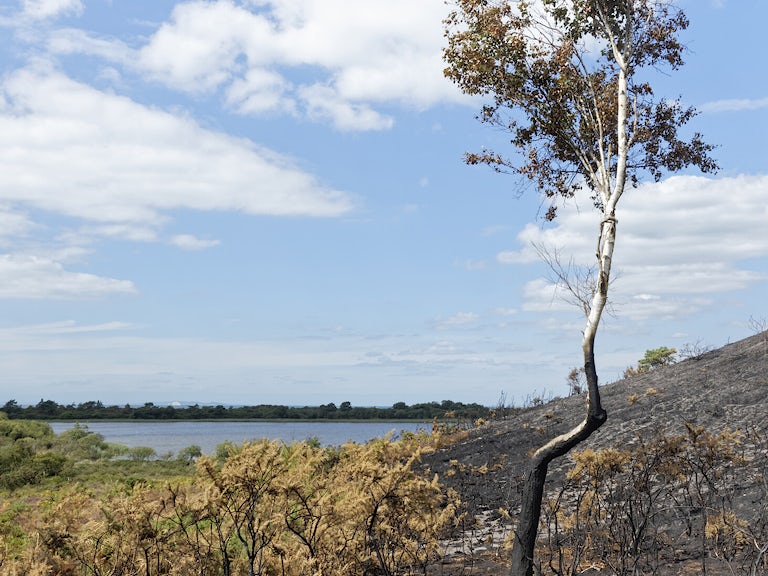
Experts agree that heatwaves caused by climate change, and ignition by people, cause wildfires across moorlands, farmland, golf courses and nature reserves. According to the National Emergencies Trust, heather, gorse, and peat are especially vulnerable.
Yet driven grouse shooting advocates – including former cricketer Sir Ian Botham writing in the Daily Mail – have blamed nature, while defending burning and draining practices which leave land bone dry and with vast swathes of monoculture ready for fire to spread.
Rebecca Wrigley, Rewilding Britain’s chief executive, said: “With high fire-risk days set to double by 2050, and flooding an increasing risk, we must move past finger-pointing. We must unite land managers, policy makers, and rural communities to protect and restore our landscapes. Rewilding can play a key role because large-scale nature restoration puts the water back into the landscape in the places where it’s meant to be.”
As well as calling for investment in rewilding, Rewilding Britain says action on wildfires needs to include better public awareness to prevent ignitions, and properly funded emergency services equipped for longer fire seasons.
– Ends –
Notes to Editors
- For details about Rewilding Britain’s Rewild to Recover campaign and open letter to the Prime Minister, visit rewildingbritain.org.uk.
- Rewilding Britain is Britain’s leading rewilding charity, working to create a wilder Britain for nature, climate and people. Rewilding Britain influences policy, removes barriers, and inspires positive, practical action to help rewilding – the large-scale restoration of nature and its remarkable web of life – flourish across at least 30% of Britain’s land and seas by 2030. Rewilding offers hope for tackling the nature and climate emergencies, while creating a cascade of benefits for people and local communities.
- All figures, unless otherwise stated, are from YouGov Plc. Total sample size was 2,079 adults. Fieldwork was undertaken between 27th — 28th August 2026. The survey was carried out online. The figures have been weighted and are representative of all GB adults (aged 18+).
- Supported by Rewilding Britain, the Rewilding Network which helps practitioners who are rewilding on land or at sea to connect, share experiences, ideas and expertise. Its 1,002 members (covering 206,556 hectares of land and 506 km² seabed rewilding) include landowners, land managers, farmers, tenants, estate owners, non-governmental organisations and community groups who are playing a vital role in addressing biodiversity loss and climate breakdown. Their work to restore nature at scale is creating economic transformations of rural and coastal communities.