The Earth is already burning — let's dampen down the flames
Britain is learning now more than ever that wildfires are no longer rare emergencies but the first wave of our new climate reality. So what are we going to do to dampen down the flames?

Published 13/08/2026
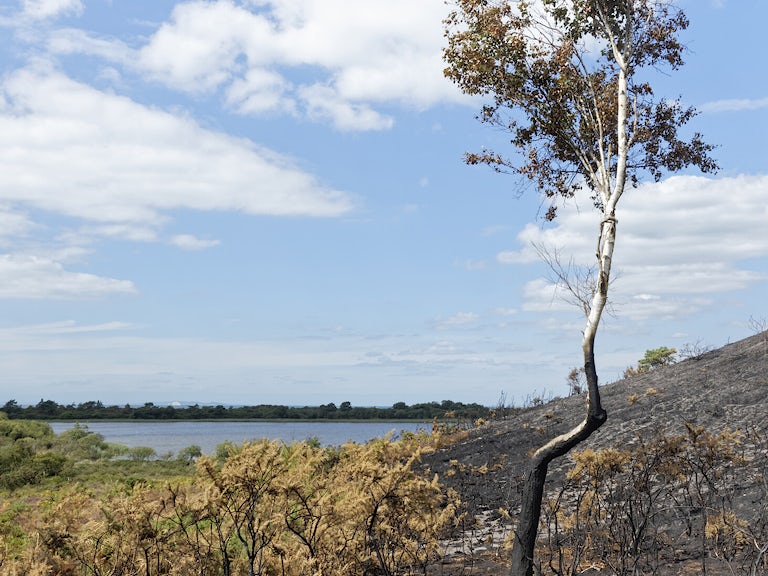
The images are becoming increasingly familiar: a helicopter circling in smoke-filled skies, ash-covered firefighters and volunteers working around the clock, and blackened hillsides scarring the landscape. From Suffolk to the Peak District, North Wales to the Cairngorms, Britain is learning now more than ever that wildfires are no longer rare emergencies but the first wave of our new climate reality. Rewilding Director Kevin Cumming sets out the ways rewilding can future-proof us from extreme weather.
Last year, wildfires in Britain burnt through a record 47,000ha of land, that’s an area more than the size of Glasgow and Birmingham combined. This year it’s on course to be worse still; by mid-summer, fire services had attended more wildfires than in the three previous years combined. Wildfires are a recurring feature of life in a rapidly warming and drying climate. As these fires become larger, more frequent and more intense, it’s not hyperbole to believe our future national resilience is at stake.
It is perhaps unsurprising that recent wildfires have reignited another debate: what role does rewilding have in Britain’s future? Some critics have been quick to blame rewilding, turning a blind eye to the evidence that rewilding is part of the solution. Simply put, rewilding reduces wildfire risk.
As our climate and landscapes shift beyond recognition, with wildfires a growing threat to people and communities, and to wildlife and landscapes, we must not confuse the preferred sterile landscape advocated for by some of rewilding’s critics with a safe one. Wildfire risk is not simply determined by the amount of vegetation present – it’s about how wet the landscape is, the type of vegetation, how diverse and healthy the mosaic of habitats is within it, how potential fuel sources are located, and how the land is managed.
Take action
We’re demanding urgent action: the UK Government must back rewilding as a vital climate change solution.

How rewilding holds the water
True resilience comes from supporting nature to do what it does best. Restoring and rewetting peatlands raises the water table, while wild beavers create water-logged habitats that act as living moisture shields.
Natural grazing of cattle, ponies and other large animals breaks up vegetation — particularly the dry thatch that can drive fast spreading flames.
By restoring a rich mosaic of native woodlands, free flowing river systems and wetlands, we allow our soils to soak up water and create natural firebreaks. In short, rewilding is an indispensable ally and toolkit for building the wetter, more complex and resilient landscapes we desperately need to stop wildfires in their tracks.
None of this happens by accident though. It takes local people, progressive land managers, environmental charities and governments working side by side to help nature bounce back and create these landscapes. In order for this to happen, we have to move beyond finger-pointing. Instead we must come together to make informed decisions about our long-term resilience. Projects in Rewilding Britain’s network now look after over 256,000 hectares of land. The rewilding movement is thriving — but to tackle climate and nature breakdown, we need to scale it up and fast.
We should remember Britain isn’t facing this emergency alone. Across Europe, governments are discovering that no amount of firefighting can compensate for landscapes that have become increasingly vulnerable to drought and fire. Suppressing flames after they ignite remains essential. But preventing fires from becoming catastrophic means investing in landscapes that hold water, break up the continuous fuel and recover more quickly.

The proof is in the peat
The proof we can do it is already here. Look at the Elan Valley in Wales, where a huge fire met its match in a newly rewetted peatland earlier this year[2]. Thanks to a raised water table, the saturated ground acted as a natural barrier. Photos from the scene show a stark difference between the scorched earth and the soggy, restored peatland. Images emerging from the recent Cairngorms wildfire show a similar story. We need much, much more of this.
Most wildfires are started by people — a discarded barbecue, a stray spark, an escaped controlled burn, an unlicensed burn (the cause of many upland fires in Spring[3]) or a deliberate act of arson. And human-driven climate breakdown is making wildfire conditions six times more likely[4] with summers predicted becoming hotter and drier.
Critical actions for a resilient Britain
There are actions that can and should be taken.
- We need better public awareness to reduce accidental and purposeful ignitions. The recent announcement from the UK Prime Minister urging all retailers to withdraw disposable barbecues is not nearly enough.
- We need better-funded fire and rescue services across our uplands — and, increasingly, in our lowlands — equipped for longer and more demanding wildfire seasons.
- We need better regulation of moorland burning.
- We need land managers, policy makers and communities working together to restore natural processes that make landscapes wetter, richer and more resilient.

Invest in rewilding the landscapes that dampen down the flames
Because it is no longer about preparing for a future threat. The climate crisis is already burning across our much-loved landscapes. Yet just 0.3% of staff are working on climate adaptation within a key government department tasked with protecting the environment and maintaining food security, a freedom of information request has revealed[5].
We cannot keep chasing the flames from one fire season to the next. We have to build landscapes that are better able to resist them in the first place.
The Earth is already burning. Our choice now is whether we continue to fan the flames, or finally invest in rewilding the landscapes that can help dampen them down.
To learn more about the steps we need to take to adapt to this new reality, read our Wildfire Resilience Policy Briefing.
- GWIS Annual Statistics for United Kingdom, (2025)
- Powys County Times, (2026) How Elan Valley peat restoration helped hold back wildfire
- Wild Cymru, (2026) Wild Cymru’s Wildfire Report
- Burton, C., Ciavarella, A., Kelley, D. I., Hartley, A. J., McCarthy, M., New, S., Betts, R. A. and Robertson, E., (2025) Very high fire danger in UK in 2022 at least 6 times more likely due to human-caused climate change
- Laville, S., (2026) The Guardian, Just 20 of 6,600 Defra staff working on climate adaptation amid drought and wildfires
Add your name
We’re demanding urgent action: the UK Government must take rewilding seriously and restore nature to keep our towns, farms and families safe from extreme weather.